|
| ||||
 
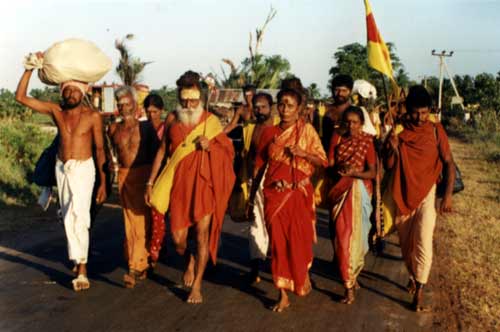
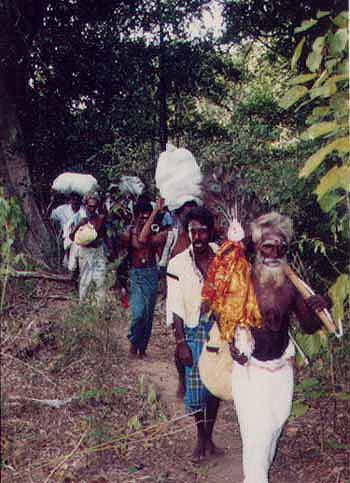
Pada Yatra pilgrims reach KataragamaCeylon Daily News (Colombo) front page news article of Thursday 18 July 2002
(M. Nelson Piyaratne, Kataragama Group correspondent)Large parties of foot pilgrims have arrived to Kataragama since the first day of the Esala Festival and many thousands more are expected to arrive before the Maha Perahera on 24 July. Many pilgrims are arriving on foot from as far as Mullaitivu, including pilgrims from India, Canada and USA as well as Sinhalese and Tamil devotees from villages all across the island. Pilgrims say that this year they have been received hospitably everywhere by security forces and local officials. Walking conditions have been difficult, with harsh sun and drought conditions prevailing especially in the 100-kilometre stretch from Pottuvil to Kataragama through Yala National Park. Meanwhile, a major effort is underway to ensure that public health as well as the natural environment is adequately protected. The Wildlife Department has been distributing educational leaflets in Sinhala and Tamil to pilgrims in the Park resulting in litter and wildfire being markedly less than last year.
Sri Lanka Army bowsers have been dispatched to Yala to provide drinking water to pilgrims at key points. Most wells inside the Park are yielding water too salty for human consumption, with the Menik Ganga being completely dry in the Park itself. Despite harsh conditions, several thousands of pilgrims are reported to be assembling at Okanda Devale annual festival in Yala East. Thousands have already begun the five to six-day march through Yala, where officials are bracing for the largest wave of foot pilgrims who are timing their journey to arrive in Kataragama during the last week of the Festival. Officials estimate that ten to fifteen thousand Kataragama pilgrims will cross Yala National Park on foot this year. Peaceful conditions islandwide, together with facilities provided by ministries and the Kataragama Devotees Trust, have combined to encourage more devotees than ever before to perform the ancient tradition of foot pilgrimage to Kataragama. For full details about Kataragama Pada Yatra visit www.PadaYatra.orgSee also these published accounts: Pada Yatra 1988 | Pada Yatra 1997 | Pada Yatra 1999 | Pada Yatra 2000 | Pada Yatra 2001  |